Cohiba is the most counterfeited cigar brand in the world. Fake boxes are sold on beaches in Cuba and the Dominican Republic, in tourist shops across the Caribbean, and through online marketplaces, often at prices that look like a bargain. A fake Cohiba is a waste of money, and you don’t know what’s inside it. This checklist shows you, step by step, how to check a Cuban Cohiba box and the cigars inside before you smoke one.
For background, see our guides to authentic Cohiba cigars in Canada and Cuban vs non-Cuban Cohiba. Remember that non-Cuban Cohiba (Red Dot, Blue, Black and others) is a legitimate product. It simply isn’t Cuban, so it won’t carry the Cuban markings below.
1. Where and how are you buying it?
Most fakes are stopped before you ever see the box. Be wary if:
- The seller approaches you, especially in the street, at a beach or a hotel, or through a contact “who works at the factory”.
- The price is far below normal retail. Behike, Siglo VI and limited editions are expensive everywhere. A deep discount is the biggest warning sign of all.
- The seller can’t or won’t show clear photos of the box, the seal and the bottom stamps.
- The listing can’t tell you whether the cigar is Cuban or non-Cuban.
2. Check the Habanos warranty seal
Every box of Cuban cigars exported by Habanos S.A. carries the green-and-white Cuban government warranty seal across one corner. Check that:
- The seal is crisply printed, with fine detail you can read with a magnifying glass, not blurry or pixelated.
- It wraps neatly from the lid onto the side of the box and is not lifted, cut or re-glued.
- Newer seals include security features and a unique code. Habanos S.A. offers a verification service for its seals on its official website.
3. Check the Habanos hologram sticker
Cuban boxes also carry a Habanos S.A. hologram sticker. The hologram should shift and show depth as you tilt it. A flat, shiny printed sticker is a red flag.
4. Read the bottom of the box
Turn the box over. A genuine hand-made Cuban Cohiba box has these heat-stamped or printed into the wood:
- “Hecho en Cuba” (Made in Cuba).
- “Totalmente a mano” (totally by hand) on hand-made lines. Machine-made formats such as Club and Mini are marked differently.
- A factory code and a date (month and year), usually stamped in ink. Missing, smudged or sticker-printed codes are a warning sign.
5. Look at the box itself
- Cuban Cohiba boxes are well finished: clean edges, neat labels and properly applied varnish or lacquer.
- Glass-top boxes are a classic sign of a fake Cohiba. Cohiba’s regular production doesn’t use them.
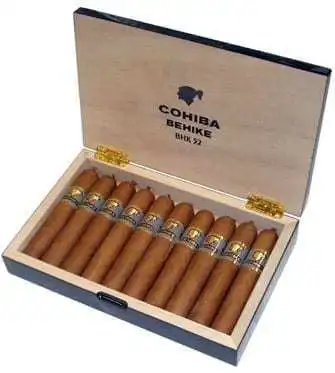
- Check the count and the size: a “box of 25” should match the official presentation for that cigar. For example, Behike comes in boxes of 10.
6. Check the bands
Since 2013, the classic Cohiba band has had a hologram and an embossed design. The Behike and Maduro 5 lines have their own distinctive bands. Look for crisp print, aligned bands, and correct colours and fonts. A band that is crooked, glued inconsistently or printed in a slightly “off” shade of orange is suspicious.
7. Inspect the cigars
- Consistency: cigars in a genuine box are closely matched in colour and shape.
- Construction: smooth wrappers, tight seams and a neat, rounded cap. Hand-made Cohibas usually show careful cap work.
- The right size: compare the length and ring gauge with the official measurements. For example, a Siglo VI is 52 × 150 mm and a Robusto is 50 × 124 mm. Every product page on our site lists the official size.
- Filler: look at the foot. Genuine hand-made cigars use long, whole-leaf filler. Chopped scraps or paper are signs of a fake.
8. Smoke test (last resort)
If you’ve already bought, the smoke will usually confirm it. Fakes tend to have a harsh, bitter, or “flat” taste, a tunnelling burn, or a plugged draw. Genuine Cohiba is smooth, with honey, cedar, cream and toasted-nut notes. Our Cuban Cohiba product pages include tasting notes for each size.
Quick checklist
- Reputable seller, realistic price
- Green Habanos warranty seal, crisp and intact
- Habanos hologram sticker that shifts in the light
- “Hecho en Cuba” and “Totalmente a mano” with a factory code and date on the bottom
- No glass top; correct count for the presentation
- Crisp Cohiba band with hologram
- Matched, well-made cigars of the correct size
How we handle authenticity at Canada Smokez
We send photos of your box, including the seal and the bottom stamps, before your order ships, so you can see exactly what you’re getting. Every product page states clearly whether a cigar is Cuban or non-Cuban. Questions? Email sales@canadasmokez.com.
Frequently asked questions
Do Cuban Cohibas come in glass-top boxes?
Glass-top Cohiba boxes are a well-known sign of counterfeits. Be very cautious.
Where is the date code on a Cohiba box?
On the bottom of the box, usually stamped in ink, along with a factory code.
Are cigars from a Cuban airport duty-free shop real?
Official Habanos shops and La Casa del Habano stores sell genuine product. The risk comes from unofficial street and beach sellers.
Tobacco products are sold only to adults of legal smoking age in their province or territory. Smoking is harmful to your health.